ArticleJun 7, 2026
Something Just Like This!
India's future feels both exhilarating and uncertain. As demographic opportunity meets systemic challenges, one question remains: how do we build a future where everyone gets a seat at the table, or better yet, helps build it?
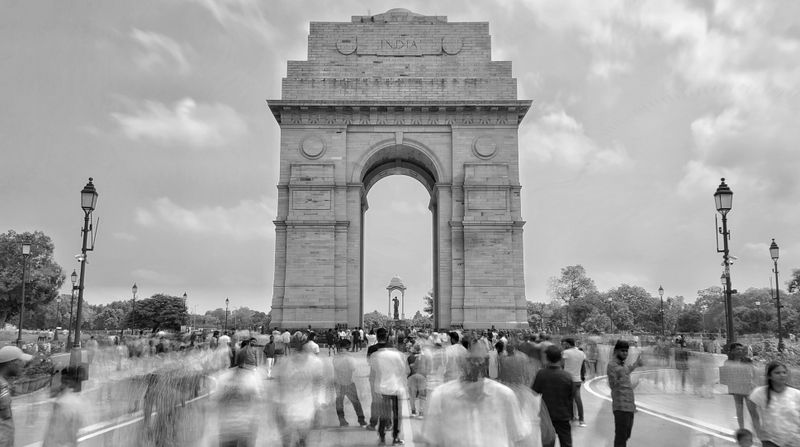
Few weeks ago, I was at the airport taking a flight back to Bangalore after my long due solo trip to Kasar Devi in a very energized and vibrant headspace. I would say this was the perfect time for me to get some fresh ideas and new perspectives and I guess universe was listening.
In a seemingly endless flight delay, I was reading this amazing book by Michael Gelb, How to think like Da Vinci on a shared table. This was one of those high tables at the airport gates which gets you a comfortable access to your phone while charging with Laptop station and somehow, I feel everyone like to grab a space there. Here I was alongside three gentlemen who happen with similar flight-got-delayed story. Let us name these gentlemen as Mr. X, Mr. Y and Mr. Z for ease of narration.
As we started chatting, I realized their backgrounds represented a fascinating cross-section of society
Mr. X is a professor in the department of Historical Studies at Delhi University and was travelling for a workshop in Mumbai to share and refine his research with his peers.
Mr. Y was working in US all those young years and now decided to come back to India because as he put it in verbatim “It’s a good time to be in India”.
Mr. Z was a young man early in his career just taking a hopping flight from Goa where he was on a break with his friends and now back to Bangalore as he had an urgent investor presentation with his founder for a startup he is working with.
To me, this group felt less like a collection of individual stories and more like a living timeline of Modern India’s transformation: post-independence India finding its identity, the 2000s IT boom leading globalization and today’s India built on innovation and grit. While I wished for more gender diversity at the table, I recognized this as a rare learning opportunity I couldn't miss.
What started as routine "What do you do?" and "Where do you live?" talk quickly evolved into a much deeper, more intriguing conversation. Despite a shared conviction that India is currently the place to be, each man voiced distinct anxieties rooted in their respective worlds:
Mr. X argued for stronger systems to connect modern India with its past. In an era where social media feeds fragmented information tailored to specific audiences, he warned that history faces erosion if validated sources aren't protected. To him, India's true strength lies in a unified narrative that bridges both the eras.
Mr. Y was worried about how we as a country are pushing the boundaries of good and bad and blurring the lines of what we call innovation and growth or is it exploitation? Of People,Resources,Planet.
Mr. Z was hyper-oxygenated by the sheer volume of market opportunities yet entirely grounded about the friction of building here citing the everyday drag of broken processes, slow institutional systems, and lagging infrastructure.
Listening in awe, I chose not to interject. Instead, I let a childlike curiosity guide me. I found myself navigating a wave of conflicting emotions — agreement, disagreement, shock, surprise, and admiration — leaving me deeply conflicted about whether to feel optimistic or concerned about our current trajectory.
After few days I landed on some research papers by E&Y and Business Standard that covered the need of maximizing a historic demographic advantage, elevating labor participation and fueling the domestic consumption engine. I will share few highlights that got my attention:
Our Bright Spots!
By 2030, India's working-age population will hit its highest historical level at 68.9% , translating to roughly 1.04 billion working-age individuals with a median age of 28.4 years
The country's dependency ratio is projected to drop to its lowest point in history at 31.2% by 2030.
India will be the Global Talent Provider supplying roughly 24.3% of the incremental global workforce over the next decade.
India establishes STEM Leadership with female STEM graduate population at 47.1%.
Female enrollment in higher education stands at nearly 49% , signaling a significant future expansion of women participating in the active labor force.
Attention Areas!
To hit the "Lewis turning point"— the economic milestone where surplus rural labor shifts cleanly into high-productivity manufacturing — India must successfully create and absorb 16 million new, highly productive jobs every single year for the next 15 years.
Over the next two decades, India is projected to house the largest elderly population in the world. Consequently, the working-age cohort is forecasted to begin its absolute decline by 2045.
External macro factors like deglobalization, AI automation, and climate change present friction ,alongside internal flaws like a North-South cultural split and low health/education metrics. If India fails to gainfully employ its youth and meet their aspirations, the demographic dividend risks turning into a source of severe social unrest.
The purpose of bringing these two contrasting realities into a single conversation is to highlight a fundamental truth: whether we look at individual perspectives or the collective macroeconomic view, we are profoundly uncertain about the future we are building. We find ourselves simultaneously optimistic about the possibilities and cynical about the systemic impacts. What is certain, however, is that whatever comes next will arrive at twice the scale.
We have pushed our intellectual boundaries to a far extent in a relatively short span of time and it’s not ending. The real balance is Go Bonkers on Innovation and Stay Sane on Sustainability. The technology led growth that we are seeing today impacts everything be it how we connect,learn,grow or live for that matter. It clearly brings new set of challenges and new questions:
Are our education systems developed to bring everyone in the arena to play?
If women don’t join the workforce at its complete scale available to us, we will not be able to take the advantage of the demographic dividend we have?
Does the ecosystem have enough resources to support child and elderly care?
Are we considering diversity of ideas to solve these newer set of problems?
Do we have support groups to make everyone opportunity ready?
Are organizations today inclusive enough change the narrative of giving a seat at the table to create a table that feeds all
If we leave these questions unanswered, how do we bring everyone to contribute to the future?
I am not saying I have the answers. No single individual has; the scale of this problem far exceeds personal capacity. However, if we act collectively, we have a fighting chance. Progress lies in coming together as small, focused communities driven by shared goals, open dialogue, and decisive action.
Communities that function on values that keep people over profits.
Communities that bring everyone in the room where the decisions are made.
Communities that don’t make space on the table but make tables to serve everyone.
Communities that connect, cultivate and connect.
Communities where we all nourish and flourish.
And it’s not new to us, as a species, we have relied on communities since our inception. We have historically come together as a singular pack, balancing each other’s strengths and weaknesses to deliver a larger goal: the welfare of all. History proves that this is an exceptionally successful way to run a society—one that ensures children, women, and men all participate with equal equity.
As people kind (I use this as a word because I feel its collective than mankind/humankind), we have come really far. We are living in the most interesting times. Technology has democratized action. If you have an intent, there is so much available to you to take the first step towards it.We all hold the power to change the world.
What a waste if we leave that power on the table?
We must build a world where we genuinely stand up for one another. A world fueled by the exchange of ideas, the power of human emotion, the joy of shared success, and the critical lessons of failure. Every experience is different, every story is unique, and every single one deserves a chance to be told. When people truly come together, they find where they belong. They change the world and that is exactly when the magic happens.
With request for consideration and beacon of hope, signing off!
Love,
Urvashi
References:
https://www.ey.com/en_in/insights/india-at-100/reaping-the-demographic-dividend